Continuous Integration
We design and implement enterprise-grade CI pipelines that automate every build, run comprehensive test suites on every commit, and enforce quality gates — so integration issues are caught in minutes, not discovered in production.
End-to-End Continuous Integration Services
From pipeline design and automated builds to comprehensive test automation, quality gate enforcement, and seamless CD handoff — we cover every stage of enterprise-grade Continuous Integration.

Accelerated Development Cycles
Automated build and test phases eliminate manual handoffs and shorten feedback loops — giving developers instant visibility into integration issues and enabling release cycles that are up to 10× faster.

Improved Code Quality
Static analysis, code coverage thresholds, and quality gates run on every commit — catching bugs, security vulnerabilities, and code smells before they reach the main branch and accumulate as technical debt.

Enhanced Collaboration
A centralised CI platform creates a shared integration environment where all team members see the same build status, test results, and quality metrics — regardless of location or time zone.

Automated Testing
Unit, integration, end-to-end, and security tests run automatically on every PR — with parallel test execution, smart test selection, and flaky-test detection to keep pipelines fast and reliable.

Cost-Efficiency
Catching defects in CI costs a fraction of fixing them post-release. Automation of repetitive build, test, and scan tasks reduces engineering overhead and frees your team to focus on feature development.

Scalability & Flexibility
Our CI solutions scale from a single-team startup to a multi-squad enterprise monorepo — with cloud-native runners, dynamic concurrency, and tool-agnostic design that adapts to your existing stack.
The RND Softech CI Advantage
We don't just configure a pipeline — we design a complete integration culture with fast feedback loops, automated quality enforcement, and a CI foundation that grows with your team and product.
Faster Feedback Loops
Developers receive build and test results in minutes — not hours. Short feedback loops mean issues are fixed while the code is still fresh, dramatically reducing the cost and time of remediation.
Built-In Security Scanning
SAST, SCA, and secret detection run as standard CI stages — surfacing vulnerabilities before they reach production, with zero developer friction and full pipeline integration.
Full Automation Coverage
From commit to artefact — builds, tests, scans, packaging, and notifications are fully automated. No manual steps, no missed quality checks, and no surprises at release time.
Tool-Agnostic Integration
We work with GitHub Actions, GitLab CI, Jenkins, Azure DevOps, CircleCI, and Bitbucket Pipelines — integrating CI into your existing toolchain without forcing costly platform migrations.
How We Build Your CI Pipeline
A structured four-phase approach — from discovery and pipeline design through automated test integration and quality gate enforcement — to a production-ready CI foundation your team can rely on every day.
Assess & Plan
We audit your current build process, test coverage, and developer workflows — identifying bottlenecks, gaps, and tooling choices before designing the CI architecture.
Build & Configure
Pipeline stages, runner environments, caching strategies, and parallelisation are configured — delivering a fast, reliable CI pipeline from the first run.
Integrate & Secure
Test suites, SAST scanners, SCA tools, and quality gates are integrated into the pipeline — automating security and quality enforcement on every commit.
Optimise & Scale
Pipeline performance is continuously monitored — with build time analysis, flaky-test remediation, and runner scaling to keep CI fast as your codebase grows.
Frequently Asked Questions
Everything you need to know about Continuous Integration services at RND Softech. Can't find your answer? Talk directly with our specialists.
Continuous Integration is the practice of automatically building and testing code every time a developer commits changes to a shared repository. The goal is to detect integration issues as early as possible — when they are cheapest and easiest to fix. CI pipelines typically include compilation, unit testing, integration testing, static analysis, and packaging as automated stages triggered by every push or pull request.
Continuous Integration (CI) covers the automated build and test stages — verifying that new code integrates cleanly with the existing codebase. Continuous Delivery (CD) extends CI by automatically preparing every passing build for release to a staging or production environment. Continuous Deployment goes further — automatically deploying every passing build to production without manual approval. Together, CI/CD forms the backbone of modern DevSecOps delivery pipelines.
We are tool-agnostic and work with all major CI platforms: GitHub Actions, GitLab CI/CD, Jenkins, Azure DevOps Pipelines, CircleCI, Bitbucket Pipelines, and TeamCity. For quality gates and static analysis we integrate SonarQube, Checkmarx, Snyk, and Semgrep. Tool selection is based on your existing stack, team size, and hosting preferences.
The CI principle recommends integrating code at least once per day — ideally on every commit or pull request. Frequent integration with short-lived feature branches (merged within 1–2 days) minimises merge conflict risk and keeps the integration delta small, making failures easy to isolate and fix. High-performing teams typically run 10–50 CI pipeline executions per day across all developers.
A build pipeline is an automated sequence of stages triggered by a code commit. Typical stages include: Checkout (clone the repository), Install (restore dependencies), Build (compile or transpile code), Test (run unit, integration, and E2E tests), Analyse (static analysis, security scan), Package (create a deployable artefact), and Publish (push to an artefact registry). Each stage must pass before the next begins — any failure blocks the merge.
A quality gate is a set of measurable criteria — code coverage percentage, number of critical vulnerabilities, duplication ratio, test pass rate — that a build must meet before it is allowed to proceed or be merged. Quality gates (implemented via SonarQube or similar tools) enforce non-negotiable standards automatically, ensuring that technical debt and security vulnerabilities cannot accumulate undetected in the codebase.
CI reduces integration bugs by keeping the integration window small. When developers integrate code frequently (daily or per-commit), the number of changes between integrations is small — making it easy to identify which change caused a failure. In contrast, infrequent integration ("big bang" merges) creates large, complex deltas where failures are hard to isolate. Teams practising CI report 90% fewer integration-related defects escaping to production compared to teams with weekly or monthly integration cycles.
Test coverage measures the percentage of your code executed by automated tests. A coverage target of 80% line coverage is a widely accepted minimum for production code, with critical business logic ideally above 90%. However, high coverage alone does not guarantee quality — we focus on meaningful test assertions and mutation testing to validate test effectiveness alongside raw coverage numbers.
Flaky tests — tests that pass and fail non-deterministically — erode developer trust in CI and cause wasted re-runs. Our approach: automatic flaky-test detection (tracking failure rate per test over time), quarantining flaky tests into a separate non-blocking suite, creating JIRA tickets for remediation with SLA tracking, and fixing root causes (timing dependencies, shared state, external service calls) using mocks, retries, and test isolation techniques.
A CI artefact is the versioned, immutable output of a successful build — a Docker image, JAR, npm package, or binary. Artefacts are stored in an artefact registry (Docker Hub, JFrog Artifactory, GitHub Packages, AWS ECR) with semantic version tags, build metadata, and provenance attestations. Immutable artefacts guarantee that what was tested in CI is exactly what gets deployed — preventing the "works on my machine" problem in production.
CI pipelines build Docker images as part of the standard pipeline — compiling the application, running tests inside containers, scanning the image for OS and dependency vulnerabilities (using Trivy, Grype, or Snyk Container), and pushing signed images to the registry on every successful build. Containerised CI runners also provide hermetic, reproducible build environments — eliminating "it built on the CI server but not locally" issues entirely.
Parallel testing splits your test suite across multiple runners that execute simultaneously — reducing total test time proportionally. A suite that takes 20 minutes on a single runner can be completed in under 3 minutes across 8 parallel runners. We implement intelligent test splitting (splitting by historical execution time to balance runner load), matrix builds for multi-platform testing, and fan-out/fan-in pipeline patterns that merge results into a unified report.
Yes — and monorepo CI is a speciality. Naïve CI configurations run all pipelines on every commit, which becomes unsustainably slow in large monorepos. We implement affected-project detection using tools like Nx, Turborepo, or custom change-detection scripts — ensuring only the services and libraries affected by a commit are built and tested. This keeps CI times fast (typically under 5 minutes) even in repositories with dozens of services.
Every CI run generates a compliance-ready audit trail: what code was built, which tests passed, which vulnerabilities were found, and which quality gates were met or failed. Security tools embedded in the pipeline (SAST for code, SCA for dependencies, container scanning for images) provide evidence for SOC 2, ISO 27001, and PCI DSS requirements. Pipeline results are immutable and timestamped — forming the build provenance record required by SLSA supply chain security frameworks.
We begin with a CI maturity assessment — reviewing your current build process, test coverage, pipeline performance, and tooling. Week 1 delivers a pipeline architecture proposal and quick wins: a working baseline CI pipeline with build, test, and lint stages. Subsequent sprints progressively add security scanning, quality gates, parallel test execution, artefact management, and CD handoff — with full documentation and team training throughout the engagement.
Ready to Build a High-Velocity CI Pipeline?
Let our DevSecOps specialists design a Continuous Integration pipeline that catches bugs in minutes, enforces quality gates automatically, and gives your team the confidence to ship faster every sprint.
Our Certifications
RND Softech maintains the highest standards of security, quality, and compliance with globally recognized certifications across all operations.
Have a Project in Mind? Let's Talk
Use our contact form for all information requests or contact us directly. All information is treated with complete confidentiality.

.webp)
Talk to Our Experts
Schedule your free consultation
More Than 250+ Clients Worldwide Work With Us
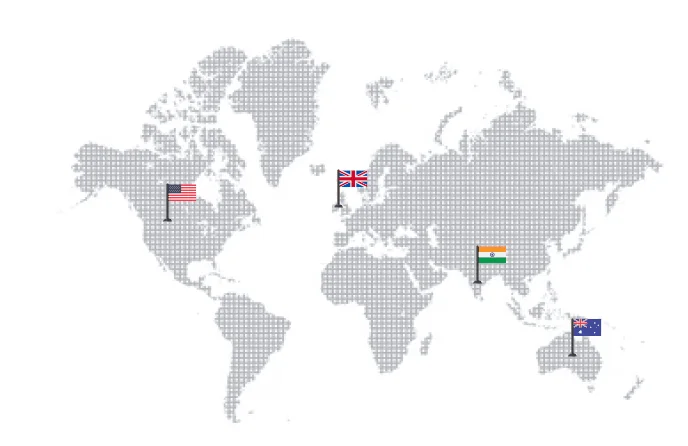
With a presence across 4 continents, we deliver exceptional back-office staffing solutions to businesses in USA, UK, Canada, and Australia.